


The Future of Facial Recognition Technology
Facial recognition is moving from a “cool demo” to an everyday utility—unlocking phones, checking in at airports, flagging suspects on security surveillance feeds, and verifying customers remotely. At the same time, it’s becoming one of the most contested forms of biometric identification, because your face is not like a password: you can’t easily change it after a breach, and it can be captured at a distance without your knowledge. The future of facial recognition technology will be shaped by two forces that often collide: demand for frictionless convenience and the push for stronger guardrails around privacy concerns, accuracy, and consent.
This article breaks down how face recognition works, where it’s headed, what risks are real (and fixable), and how to choose or deploy facial recognition systems responsibly—whether you’re a business leader, developer, HR manager evaluating a facial recognition time clock, or simply someone wondering why your phone recognizes you but a camera sometimes doesn’t.

How face recognition works (from pixels to a match)
Most people use “face ID” and “facial recognition” interchangeably, but the pipeline usually includes multiple stages. Understanding them helps you evaluate claims like “99% accurate” and spot where errors arise.
Step 1: Face detection (finding a face in an image)
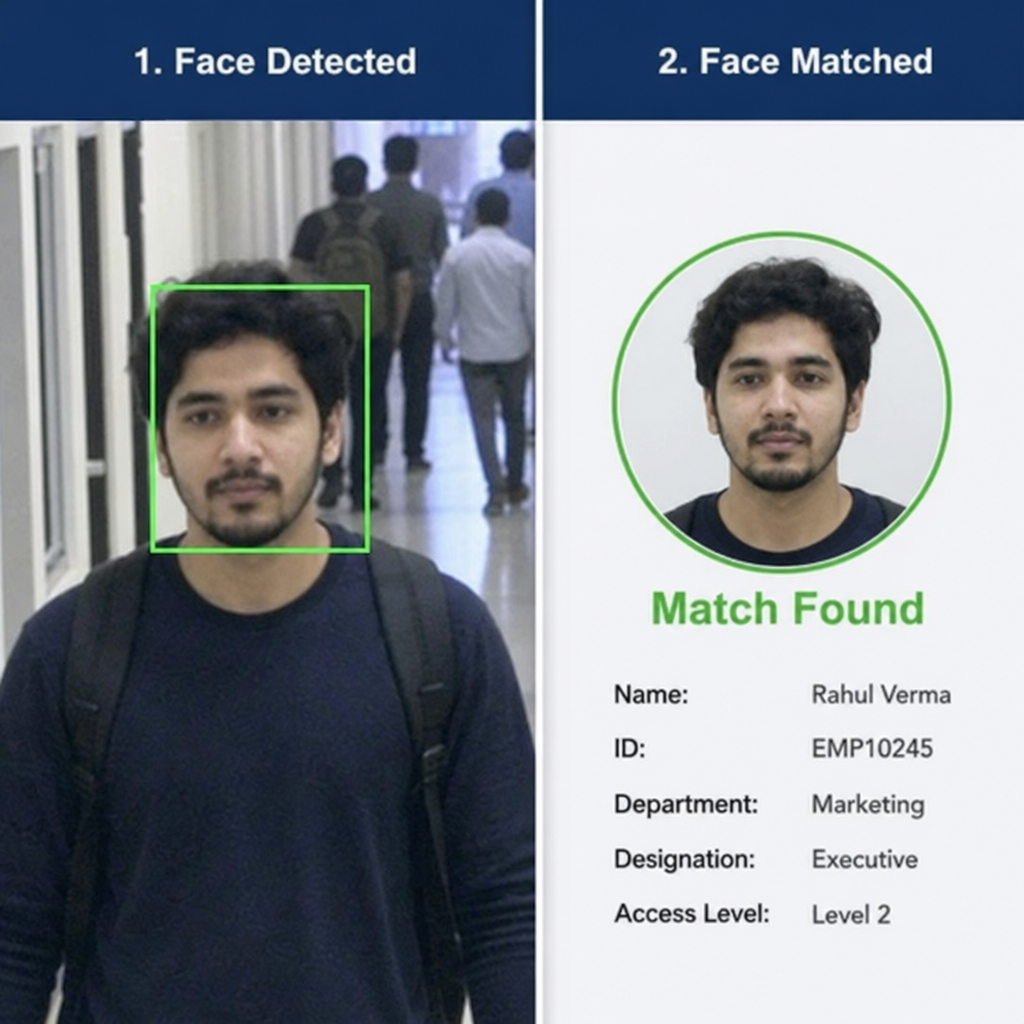
Face detection software locates faces within an image or video frame—often drawing a bounding box around them. This is not the same as identifying who the person is.
- This stage is sometimes provided by general image recognition tools.
- It’s common in cameras that auto-focus on faces or enhance portraits.
- Many products advertised as facial recognition software for photos are primarily detection + clustering, not verified identity.
Face detection vs biometrics: detection answers “Is there a face here?” while biometrics aims to answer “Whose face is this?” Detection can be very good and still lead to poor identification if the next steps are weak.

Step 2: Feature extraction (creating a face template)
Modern systems use deep neural networks to convert a face image into a mathematical representation (often called an embedding or template). This is where ai facial analysis and facial biometrics really begin.
- Good models learn robust features like relative geometry and texture patterns.
- The template is not a photo, but it can still be sensitive personal data.
This stage is often powered by deep learning face matching models trained on large datasets.
Step 3: Matching (1:1 verification vs 1:N identification)
The system compares templates and produces a similarity score.
- Identity verification (1:1): “Am I the authorized user?” Example: unlocking a phone or a workplace badge replacement.
- Identification (1:N): “Who is this person among many?” Example: searching a watchlist in security surveillance footage.
The false positive identification problem grows with 1:N search because the system is comparing against many people. Even a low false match rate can become meaningful at scale.
Step 4: Decision + human process
A threshold converts the similarity score into “match / no match.” The future isn’t only about better models; it’s also about better workflows:
- Human review for high-stakes decisions
- Audit logs
- Clear escalation steps
- Dispute and correction processes
These operational layers are often what separates “useful” from “harmful.”
What’s powering the next wave of facial recognition technology
Facial recognition has improved dramatically, but the next phase is about making it more trustworthy, harder to trick, and easier to govern.
1) Better robustness in the real world
Research and engineering focus on face recognition accuracy factors that commonly break systems:
- Low light / glare / backlighting
- Motion blur and compression artifacts
- Off-angle faces (profile views)
- Occlusions (masks, hats, hair, glasses)
- Aging and facial hair changes
- Camera quality differences (phone vs CCTV)
This is why choosing the right camera for facial recognition matters as much as the algorithm. A high-end model can still fail on grainy footage.

2) Liveness detection to prevent spoofing
As systems spread, so do attacks: printed photos, screen replays, deepfake videos, and masks.
A major trend is preventing spoofing attacks liveness detection:
- Passive liveness: analyzes subtle cues (texture, reflection, micro-motions)
- Active liveness: prompts user actions (blink, turn head, follow a dot)
- Multi-sensor approaches: depth, IR, or additional signals on supported devices
Liveness isn’t perfect, but it’s becoming standard in consumer authentication and remote onboarding.
3) On-device and edge processing for privacy and speed
More matching is happening locally (phones, kiosks, access control devices) rather than sending everything to the cloud:
- Lower latency
- Reduced data exposure
- Better compliance posture
This is one reason comparisons like iPhone Face ID vs Android matter: the hardware stack and secure enclaves differ by ecosystem, and the “best” choice depends on threat model, not just convenience.
4) Specialized systems for enterprise workflows
In workplaces and healthcare, facial recognition is increasingly integrated into identity and access management.
A frequent search term is imprivata facial recognition, because vendors in regulated environments focus on auditability, integration, and strong policy control rather than consumer-style gimmicks. The future is less about a single “magic” model and more about well-governed identity ecosystems.
Where facial recognition systems are expanding (and where they’re stalling)
Facial recognition will not “take over everything.” Adoption is uneven because contexts differ in risk, legality, and tolerance for error.
High-growth use cases
1) Secure authentication and account recovery
- Passwordless login
- Step-up verification for sensitive actions
- Customer onboarding (especially financial services)
2) Workplace attendance and access control The facial recognition time clock is attractive because it reduces buddy-punching and badge sharing. Expect more adoption—alongside more labor scrutiny—especially where unions, regulators, and employees demand safeguards.
3) Photo organization and consumer apps People want facial recognition software app features like:
- Grouping photos by person
- Searching “photos of mom” quickly
- Auto-tag suggestions
Here, the biggest differentiator will be privacy-by-design: opt-in clustering, local processing, and transparent deletion controls—especially for products marketed as facial recognition software for photos.
4) Physical security In controlled environments (data centers, labs, stadium staff areas), face matching can add convenience. In public spaces, broad deployment is more controversial and policy-restricted.

Where deployment is slowing or facing pushback
Mass identification in public surveillance is the most contested: risks include misidentification, chilling effects, and opaque watchlists. Public trust depends on transparency, due process, and clear limitations.
The hard problems: bias, misidentification, and real-world harm
The future conversation is increasingly shaped by accountability. People don’t just ask “Does it work?” but “Who does it work for, under what conditions, and with what recourse if it fails?”
Dataset bias in AI systems
Dataset bias in AI systems can arise when training data under-represents certain demographics, lighting contexts, or regions.
Consequences:
- Higher error rates for some groups
- Unequal burden of misidentification
- Erosion of trust and higher legal risk
Bias mitigation is not one fix; it’s an ongoing lifecycle practice: data auditing, subgroup performance reporting, threshold tuning per use case, and independent evaluation.
The false positive identification problem (and why it’s so persistent)
False positives often spike when:
- The database is huge (1:N search)
- The threshold is set aggressively
- Images are low quality
- There is pressure to “find a match”
It’s especially dangerous when a “match” is treated as evidence rather than a lead. A frequently discussed example in public debates is the case often referenced as angela lipps was wrongfully jailed after ai facial recognition error—a shorthand people use when discussing how identification errors can cascade into real harm. Regardless of the specific case details someone cites, the underlying lesson is consistent: without rigorous verification steps, audit trails, and human review, an algorithmic match can become an unjust outcome.
Actionable safeguard: treat facial recognition matches as investigative signals, not sole proof, and require corroboration.

Privacy concerns and biometric authentication privacy risks
Even a highly accurate system can be unacceptable if it’s deployed without consent, transparency, or control. This is why privacy concerns and biometric authentication privacy risks are central to the future.
Why facial biometrics are uniquely sensitive
- Your face is publicly exposed in many settings
- Collection can be passive (cameras) rather than active (fingerprint scan)
- A “template” can still be linked across contexts
- Breach impact is long-lived—you can’t rotate your face like a password
Core privacy-by-design practices
If you’re implementing facial recognition, prioritize:
- Data minimization: store less, retain less, collect only when needed
- Purpose limitation: don’t reuse for unrelated objectives
- Local processing where possible: reduce data transfer
- Strong security controls: encryption at rest/in transit, access logging
- Transparent notice: clear signage and plain-language policies
- User control: opt out face scanning where feasible, or provide alternatives
Consent laws for biometric data and GDPR compliance for biometrics
Regulation is a moving target, but two themes are consistent:
- Many jurisdictions treat biometrics as sensitive data requiring heightened protections and, often, explicit consent—especially in employment contexts (think consent laws for biometric data).
- In the EU, GDPR compliance for biometrics typically means having a lawful basis, strong necessity justification, clear retention limits, and robust rights handling (access, deletion, objection), plus careful vendor management.
Practical tip: before deployment, write a “biometric impact assessment” that documents purpose, necessity, risks, mitigations, and user rights. This is becoming a de facto expectation even when not strictly mandated.
Legal and reputational flashpoints (what brands can learn)
Consumers increasingly punish brands that use face scanning without clear consent. A commonly searched example is the mac cosmetics facial recognition lawsuit, which reflects a broader pattern: if facial biometrics are used in a way users perceive as hidden, coercive, or disproportionate, the backlash can outweigh the benefit.
Whether you’re in retail, beauty, hospitality, or events, the future-proof approach is:
- Make face scanning opt-in, not default
- Offer non-biometric alternatives
- Avoid collecting minors’ biometric data without stringent safeguards
- Explain the value exchange plainly (“why we use this and what you get”)
Choosing the right technology: what “best face recognition software” really means
Searching for the best face recognition software can lead to misleading comparisons. “Best” depends on the scenario.
A decision framework (use-case first)
Ask:
- Is this identity verification (1:1) or identification (1:N)?
- What’s the consequence of error? (unlock phone vs deny entry vs law enforcement lead)
- What camera conditions exist? (controlled kiosk vs outdoor street)
- Are you allowed to collect biometrics here? (employment, minors, public space)
- Do you need liveness? (remote onboarding almost always does)
What to evaluate in vendors and tools
Whether you’re buying an enterprise platform or a developer SDK:
- Subgroup performance reporting (to address bias)
- Real-world testing support (not just benchmark claims)
- Liveness detection options and spoof resistance
- Security posture and compliance support
- Retention and deletion controls
- Integration with IAM and audit logs
- On-device/edge options
- Clear documentation on thresholds and tuning
For consumer-oriented tooling like facial recognition software app products or facial recognition software for photos, also evaluate:
- Local-only mode
- Ability to disable uploads
- Transparent model behavior (what is stored, what is shared)
Face recognition alternatives for security (when you shouldn’t use a face)
In many cases, face recognition alternatives for security are safer, simpler, or more acceptable.
Consider:
- Physical badge + PIN (still common, easy to govern)
- FIDO2/WebAuthn security keys (strong phishing resistance)
- Device-based authenticators (hardware-backed where possible)
- QR-based session handoff for low-risk check-ins
- Palm-vein or fingerprint in controlled settings (still biometric; different tradeoffs)
Use facial recognition when it meaningfully improves security and you can deploy it with consent, transparency, and strong controls.
Implementation playbook: deploying facial recognition responsibly
If you’re building or adopting facial recognition systems, treat governance as part of the product.
1) Define and document the purpose
Write a tight purpose statement:
- “Verify an employee is the enrolled user at clock-in” (time clock)
- “Unlock a device for the enrolled owner” (consumer)
- “Verify a customer’s selfie matches their ID photo” (remote onboarding)
Avoid vague goals like “improve security” without specifying what threat you’re mitigating.
2) Choose verification over identification when possible
Whenever you can, prefer 1:1 identity verification to 1:N identification. It’s typically:
- less invasive
- less error-prone at scale
- easier to justify legally
3) Add liveness and anti-spoofing
For remote flows, preventing spoofing attacks liveness detection is often mandatory. Log liveness outcomes and tune thresholds.
4) Build a human-centered exception path
When the system fails:
- Provide a fast fallback (PIN, ID check, help desk)
- Avoid locking someone out indefinitely
- Document appeals and corrections
This matters for employee trust and customer retention.
5) Retention, deletion, and opt-out by default
A future-proof policy includes:
- short retention windows for raw images
- limited retention for templates
- role-based access controls
- documented deletion and opt out face scanning processes
For developers: training and tuning a model (without breaking trust)
Some teams will choose to train a face recognition model—especially for specialized environments (uniforms, helmets, masks) or edge deployment constraints.
What you should do (and what you should avoid)
Do:
- Use consented, well-documented datasets
- Measure performance across demographics and conditions
- Separate dev/test to avoid leakage
- Calibrate thresholds per use case and risk level
- Conduct red-team testing for spoofing and adversarial attempts
Avoid:
- Scraping faces without consent
- Using a single “global” threshold for all contexts
- Ignoring camera and compression effects in evaluation
- Deploying identification in public spaces without strict governance
A realistic view of “AI facial analysis”
Many vendors bundle “emotion,” “age,” or “attention” inference into ai facial analysis. The future will likely include more skepticism and regulation here, because these attributes can be unreliable, culturally biased, or ethically problematic. If you don’t need it, don’t collect it.
The device experience: iPhone Face ID vs Android and beyond
Consumers often compare iPhone Face ID vs Android as if it’s one feature. In reality, “Android” spans many manufacturers and sensor configurations.
Future trends:
- More devices will incorporate better depth sensing and secure hardware
- More authentication will be on-device, with fewer cloud dependencies
- Cross-app passkeys will reduce pressure to use face everywhere
Takeaway: device-based face unlock is usually best when it’s hardware-backed and local, while cloud-based face login requires more scrutiny (liveness, storage, and breach impact).
What the future likely looks like (2026 and beyond)
Expect these shifts to define the next decade of facial recognition technology:
From “can we match?” to “should we match?” Governance and consent become product requirements, not legal afterthoughts.
More privacy-preserving architectures Edge processing, encrypted templates, shorter retention, and tighter purpose controls.
Higher standards for evidence and accountability Especially where misidentification can cause harm, the system will need robust auditing, human review, and dispute resolution.
Stronger buyer expectations and certification-style testing Enterprises will demand proof of performance under realistic conditions and transparency about face recognition accuracy factors.
More alternatives and multimodal verification Combining signals (device possession, passkeys, liveness) reduces reliance on face alone.
Conclusion: a future built on trust, not just speed
The future of facial recognition will be defined less by flashy demos and more by responsible deployment: clear purpose, strong security, measurable performance, and respect for human rights. Done well, facial recognition technology can streamline identity verification, reduce fraud, and improve user experience. Done poorly, it amplifies privacy concerns, worsens the false positive identification problem, and invites legal and reputational fallout.
If you’re evaluating or deploying facial recognition systems, the simplest rule is this: prioritize consent, minimize data, verify performance in your real conditions, and always provide a non-biometric alternative. That’s how facial biometrics becomes a tool people choose—rather than a system they fear.
Estimated word count (article body): ~4,900 words.