


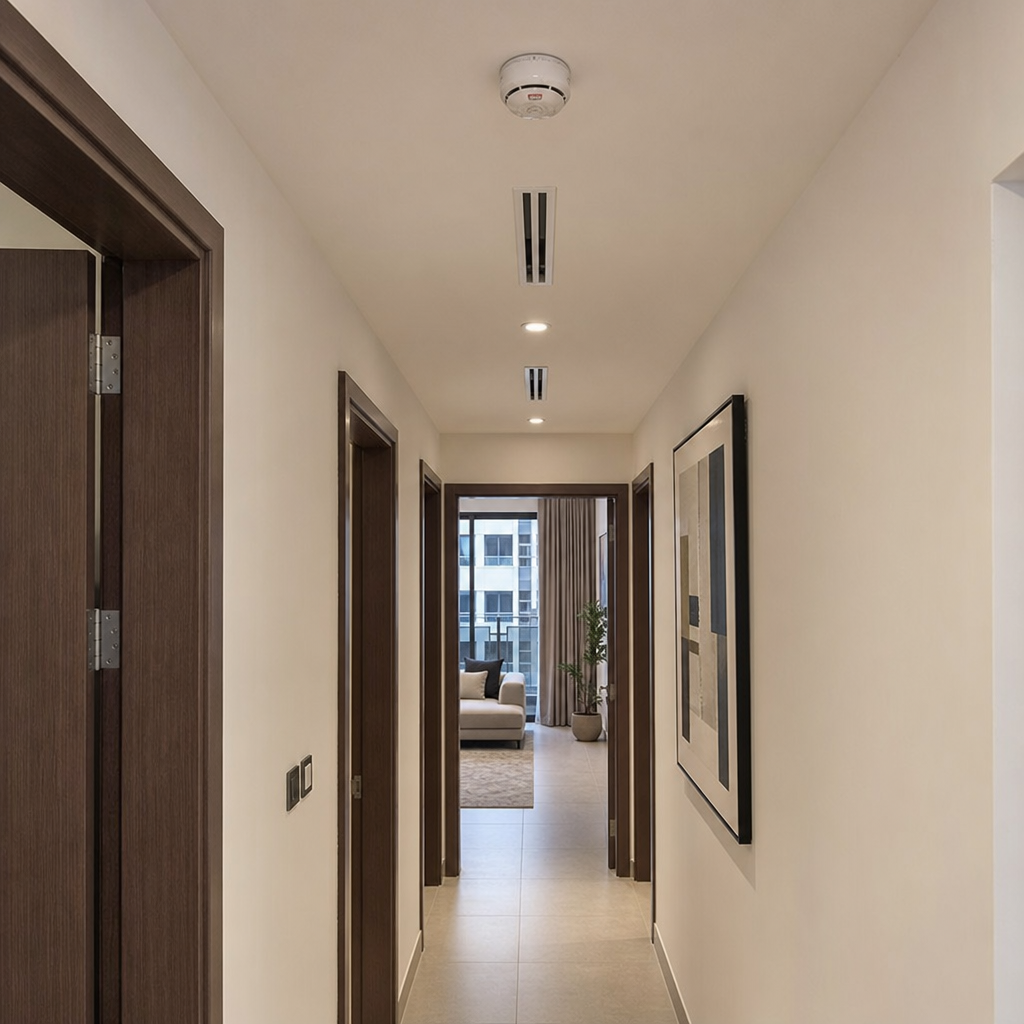
How to Test Smoke Detectors
Smoke detectors are one of the simplest fire safety devices you can have—yet many homes and flats across the UAE only discover a problem when it’s too late (or at 2 a.m. when the unit starts chirping). In a region where air conditioning runs most of the year, dust builds up quickly, and busy households include everything from studio apartments in Dubai Marina to family villas in Abu Dhabi and Sharjah, smoke detector maintenance is not optional—it’s part of smart home fire safety.
This guide explains how to test smoke detectors the right way, including a smoke detector test without smoke, a full smoke detector test button procedure, and practical steps for hardwired, wireless, and interconnected units—plus fixes for the most common issues like smoke detectors going off for no reason, smoke detector chirping fix, and why smoke detector beeping after battery change.

Why testing matters (especially in the UAE)
A smoke alarm that looks fine can still fail due to dust, battery issues, age, humidity, or wiring faults. Regular testing helps ensure your home safety equipment works when you need it.
Common UAE-specific factors that affect reliability:
- Dust and sand entering through windows, balconies, and ventilation
- High humidity (especially in coastal areas) affecting sensor performance
- Frequent AC use moving air around the detector and pulling dust into the chamber
- Cooking styles (high-heat frying, grilling, and aromatic spices) increasing nuisance alarms
- Apartment building fire alarm systems where a unit may be connected to communal alarms
Bottom line: how often to test smoke alarms should not be an afterthought—build it into your routine.
Smoke detector types: know what you have first
Before testing, identify your smoke detector types, because the correct approach differs.
Ionization smoke detectors
- Often faster at detecting fast-flaming fires
- More prone to nuisance alarms from cooking
- Still common in older installations
Photoelectric smoke detectors
- Often better for smouldering fires
- Generally fewer false alarms in kitchens near living areas
- Frequently recommended as a “best smoke alarm for home safety” pick in many smoke detector reviews
Dual-sensor smoke detectors
- Combine ionization + photoelectric
- A popular option among the best smoke detectors for broad coverage
Hardwired vs battery vs wireless smoke detectors
- Hardwired: connected to building power, usually with battery backup
- Smoke detectors 10 year battery: sealed lithium units designed to last up to a decade
- Wireless smoke detectors: communicate via radio link; great for retrofits and villas without rewiring
Interconnected alarms
If one alarm triggers, all sound. This can be via wiring or wireless. You’ll use an interconnected smoke alarm test method (covered below).
Smoke alarm vs carbon monoxide detector (don’t mix them up)
Smoke alarm vs carbon monoxide detector is a common confusion.
- A smoke detector senses smoke/combustion particles.
- A carbon monoxide (CO) detector senses CO gas (often from fuel-burning appliances).
Many homes benefit from both. Some combo units exist, but ensure you’re following the right smoke alarm installation and testing instructions for each sensor type.

How often to test smoke alarms (simple schedule)
A realistic schedule for UAE households:
- Weekly or monthly: Press the test button (monthly is the usual minimum)
- Every 3–6 months: Clean the unit (more often if you notice dust buildup)
- When moving in / after renovations: Full test + check placement
- After any nuisance alarms: Inspect and troubleshoot immediately
- At the smoke alarm expiration date replacement point: Replace the unit (typically 10 years; check the label)
If you manage multiple properties or short-term rentals, use a formal smoke alarm maintenance checklist.
Smoke alarm maintenance checklist (quick, practical)
Use this as a repeatable routine:
- Confirm the alarm is securely mounted (no wobble)
- Press test button and confirm loud sound
- Check indicator LED behavior (varies by model)
- Vacuum dust around vents (no liquids)
- Confirm battery status / backup battery presence
- Confirm date of manufacture and smoke alarm expiration date replacement timeline
- Verify coverage and smoke detector placement guidelines
- For interconnected systems: test the linking (wired or wireless)
Print this and keep it near your circuit breaker panel or maintenance folder.
How to test smoke detectors using the test button (the safe baseline)
For most homes, the safest starting point is the built-in test function. This checks the horn/speaker and basic circuitry.
Smoke detector test button procedure
- Stand under the alarm (use a stable step stool if needed).
- Press and hold the Test button for 5–10 seconds (some models beep immediately; some take longer).
- Listen for:
- A loud, continuous alarm tone, or
- A patterned beep sequence (model-dependent)
- If your unit is interconnected, confirm other alarms also sound (if they should).
- Release the button and confirm the alarm stops within a few seconds.
If it’s weak or silent, move to smoke detector not working troubleshooting below.
This method also counts as a smoke detector test without smoke (because it doesn’t verify sensor sensitivity—only the alarm function).

Smoke detector test without smoke (what it can and can’t tell you)
Many people prefer not to create smoke indoors—especially in flats with shared corridors.
A smoke detector test without smoke can include:
- Test button (checks alarm sound + electronics)
- App-based self-tests (for smart models)
- Diagnostic LEDs/status indicators
What it does not fully confirm:
- Whether the sensor chamber detects smoke properly
- Whether dust contamination has reduced sensitivity
That’s why occasional sensor testing matters, especially in dusty environments.
How to do a real sensitivity test (recommended occasionally)
If you want to confirm actual detection performance, use a purpose-made product.
Smoke detector sensitivity test aerosol (best practice)
A smoke detector sensitivity test aerosol is designed to simulate smoke particles safely.
Steps:
- Open windows/ensure ventilation (especially important in smaller UAE apartments).
- Read the aerosol instructions carefully.
- Spray a short burst near (not directly into) the detector intake vents.
- The alarm should trigger within the specified time.
- Silence/reset the alarm per your model.
Avoid “DIY smoke” methods (burning paper, incense, or matches) because they can:
- Contaminate the sensor
- Leave residue
- Trigger building-wide alarms or security calls
- Create unnecessary fire risk

Hardwired smoke alarm testing steps (for apartments and villas)
Hardwired alarms are common in many buildings.
Hardwired smoke alarm testing steps
- Press the test button (as above).
- Check the indicator light:
- Steady, blinking, or color changes vary by model
- If the alarm is interconnected, confirm other alarms also sound.
- If it fails:
- Check the circuit breaker (some alarms are on a lighting circuit)
- Confirm the backup battery is installed (if the model has one)
- Inspect for loose mounting or wiring issues (do not open wiring if you’re not qualified)
If you suspect wiring issues, contact building maintenance or a licensed electrician familiar with local requirements and your building’s fire alarm systems.
Interconnected smoke alarm test method (wired or wireless)
Interconnected alarms are great for safety—if they’re actually linked properly.
Interconnected smoke alarm test method
- Choose one alarm (often the nearest to bedrooms).
- Press and hold Test.
- Confirm:
- The initiating alarm sounds
- Other alarms in the home sound within a short delay (often a few seconds)
- Repeat from a different alarm to ensure the network works both ways.
For wireless smoke detectors, also verify:
- Signal/link indicator in the app (if supported)
- Battery levels on all linked units
Smoke detector placement guidelines (quick UAE-friendly tips)
Proper placement is part of testing—if it’s installed poorly, it may “work” but still fail to warn in time.
General smoke detector placement guidelines:
- Place detectors in:
- Hallways outside bedrooms
- Each bedroom (recommended)
- Living areas
- Each floor of the home (villas: every level)
- Keep away from:
- Directly above cooktops (nuisance alarms)
- AC supply vents (airflow can delay smoke reaching the sensor)
- Bathrooms (steam)
- Mounting basics:
- Ceiling is usually best
- If wall-mounted, follow manufacturer distance from the ceiling line
If your alarm frequently triggers during cooking, consider repositioning slightly (while still meeting safety coverage) or switching to photoelectric models—often featured in smoke detector reviews as better for kitchens.

Smoke detector maintenance: cleaning (dust is the silent killer)
In the UAE, dust is a top reason alarms become unreliable or overly sensitive.
Cleaning steps:
- Turn off power at the breaker for hardwired units (if recommended by the manufacturer).
- Use a vacuum with a soft brush to clean vents and the outer casing.
- Use compressed air lightly if allowed by the manufacturer.
- Wipe the outside with a dry or slightly damp cloth (never spray cleaner into vents).
- Restore power and re-test.
Good smoke alarm tips: Put cleaning on your calendar at the start of summer and mid-winter, when AC usage patterns often change.
Battery care: replacement guide and common beeping problems
Battery issues are behind most service calls.
Smoke detector battery replacement guide
- Remove the alarm from the bracket (twist or release latch).
- Open the battery compartment (if not sealed).
- Replace with the correct type (commonly AA or 9V; check the label).
- Close compartment fully (some units won’t mount if it’s not shut).
- Reattach the alarm and press Test.
Smoke detectors 10 year battery: what to know
Sealed units aren’t meant for battery swaps. If it chirps near end-of-life:
- You typically replace the entire unit (not just the battery).
- Check the manufacturing date and end-of-life label.
Why smoke detector beeping after battery change
If you replaced the battery and it still chirps:
- The battery may be weak/expired (even new packs can be old stock)
- The battery is inserted incorrectly
- The alarm needs a reset (some require holding Test for 10–20 seconds)
- The alarm is at end-of-life and is warning you to replace it
- Dust in the chamber is causing errors
Smoke detector chirping fix (quick checklist)
Try, in order:
- Confirm correct battery type + fresh brand-name battery
- Clean the unit (vacuum vents)
- Reset (hold Test per manual)
- Check for end-of-life date
- Replace the alarm if still chirping
Smoke detector not working troubleshooting (when the test button fails)
If pressing Test does nothing:
Check these fast:
- Battery (installed, correct orientation, not dead)
- Power (hardwired breaker on; unit seated properly)
- Mounting (some alarms have a safety tab that must be engaged)
- Unit age (expired alarms may not respond reliably)
- Internal fault (common after power surges or humidity exposure)
If it’s hardwired and you’re unsure, don’t guess—use building maintenance or a qualified electrician. With communal fire alarm systems, incorrect handling can create false building alarms or leave you unprotected.
Smoke detectors going off for no reason (what’s really happening)
It’s rarely “no reason.” Common causes:
- Dust or insects in the sensing chamber
- Steam from showers nearby
- Cooking aerosols (oil, high-heat grilling)
- Strong airflow from AC vents pushing particles in
- Low battery (some models chirp; others can false alarm)
- End-of-life sensor drift
- Electrical issues in hardwired systems (less common, but possible)
Fix approach:
- Note time + location (is it always near the kitchen? always at night?).
- Clean the unit thoroughly.
- Relocate if placement is wrong (see smoke detector placement guidelines).
- Consider upgrading to photoelectric or dual-sensor models often listed among the best smoke detectors.
- If it’s a pattern across multiple alarms, inspect your system setup (especially for interconnected alarms).
E cigs and smoke detectors: can smoke detectors detect vape?
People ask this a lot—especially in flats where someone is worried about setting off an alarm.
Can smoke detectors detect vape?
Sometimes, yes. Vapour from e cigs and smoke detectors can interact depending on:
- The detector type (photoelectric units can be more responsive to airborne particles/aerosols)
- Distance from the detector
- Ventilation and humidity
- Density of vapour clouds
So the practical answer to can smoke detectors detect vape is: it can happen, particularly if vapour is exhaled directly under/near the detector or in a small, poorly ventilated room.
Practical guidance:
- Avoid vaping near detectors.
- Use ventilation and keep vapour away from ceilings.
- If nuisance alarms happen, don’t disable alarms—adjust behavior and placement where appropriate.
Replacing smoke detectors: when testing reveals it’s time
Testing often leads to the bigger question: when do you stop fixing and start replacing smoke detectors?
Replace the unit if:
- It’s at/near its expiration (commonly 10 years—check the label)
- It fails the test button check even after battery replacement and cleaning
- It frequently nuisance-alarms despite good placement and cleaning
- The casing is yellowed, cracked, or damaged
- It’s an older model and you want improved detection + quieter false-alarm behavior
Smoke alarm expiration date replacement
Most alarms have a manufacture date on the back. Use that to set a replacement reminder.
If you’re shopping, look for:
- Clear labeling and local compliance
- Strong sound output
- Easy hush/silence button
- Interconnect compatibility if you need it
- Sealed smoke detectors 10 year battery for low-maintenance homes
- Options that integrate with home safety equipment ecosystems (where appropriate)
This is where reading smoke detector reviews helps—focus on reliability, nuisance alarm rate, and ease of testing.
Smoke alarm installation notes (so your next test is easier)
Good smoke alarm installation reduces future problems:
- Mount firmly (no wobble)
- Avoid paint over-spray or plaster dust in renovations (cover alarms during work)
- Label installation date inside your maintenance log
- If using wireless smoke detectors, confirm every unit is linked before final mounting
- For hardwired alarms, ensure a qualified person handles wiring and verifies connection to the correct circuit if required
Fire safety devices beyond smoke detectors (small upgrades, big gains)
Smoke alarms are key, but consider rounding out your setup:
- Fire extinguisher suitable for kitchen use
- Fire blanket near cooking area
- Emergency torch (power cuts)
- CO detector where fuel-burning appliances exist
- Family exit plan (especially for multi-level villas)
These fire safety devices work best as a system—think “layers” of protection for home fire safety.
Quick takeaway
To protect your household, make how to test smoke detectors a routine: use the smoke detector test button procedure monthly, clean for dust as part of smoke detector maintenance, and occasionally confirm detection with a smoke detector sensitivity test aerosol. If you’re dealing with constant chirping, nuisance alarms, or expired units, follow the smoke detector battery replacement guide and don’t hesitate to prioritize replacing smoke detectors—especially when you’re aiming for the best smoke alarm for home safety in UAE conditions.
Estimated word count (article body): ~2,850 words.