


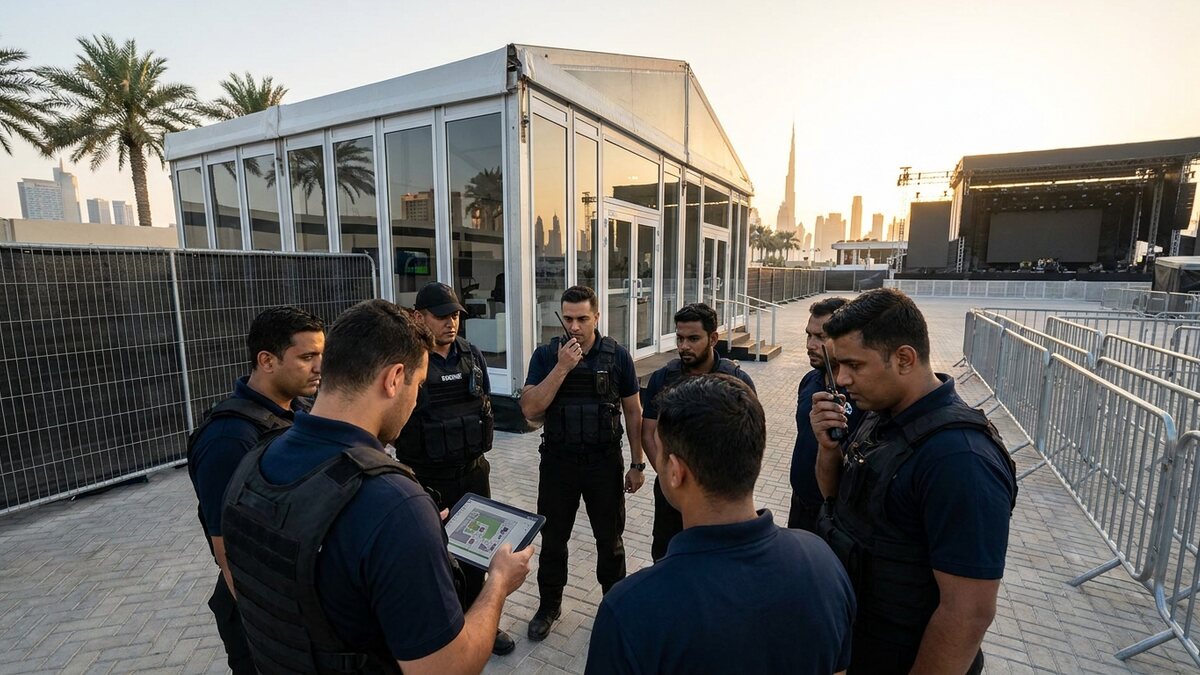
The way a business manages backstage security services affects safety, continuity, service quality and the experience of everyone who enters a property. For organisations that want dependable results, backstage security services should be approached as an operating system rather than a one-time purchase. An event concentrates people, suppliers, temporary infrastructure and tight deadlines in one place. Good event security supports the guest experience by making arrival, movement and response feel organised, while remaining ready for medical, fire, crowd or access incidents. This guide focuses on restricted areas and gives property owners, facilities teams and decision-makers a structured way to move from a broad requirement to a workable plan.
The framework is intentionally practical and general. Validate authority requirements, technical limits and contractual responsibilities for the specific Dubai site.
Why this topic deserves a site-specific plan
Operational detail determines whether the plan works at this particular property. The operating environment should drive the plan: who is present, what can change quickly, which failures matter and how managers want those failures reported.
In practical terms, begin by writing a short outcome statement: what should be protected or improved, who owns the decision, what evidence will demonstrate success, and what must happen when the normal process fails. This keeps discussions about backstage security services focused on results instead of isolated features.
Key risks and planning questions
A useful review should consider at least the following exposure points:
- Credentials that are easy to share or misunderstand: Clarify when it could occur, who should notice it, the first response and the record needed for follow-up.
- Contractors entering through uncontrolled routes: Clarify when it could occur, who should notice it, the first response and the record needed for follow-up.
- Overcrowding near stages or attractions: Clarify when it could occur, who should notice it, the first response and the record needed for follow-up.
- VIP zones without clear boundaries: Clarify when it could occur, who should notice it, the first response and the record needed for follow-up.
- Lost children or vulnerable guests: Clarify when it could occur, who should notice it, the first response and the record needed for follow-up.
- Weather and heat affecting outdoor operations: Clarify when it could occur, who should notice it, the first response and the record needed for follow-up.
Risk increases when several ordinary weaknesses overlap. Compare the points against busy periods, restricted areas and response capacity, then validate assumptions through observation and testing.
A practical restricted areas framework
- Calculate staffing by role, zone and operating period. Design records around their purpose. Managers should know which fields drive action and remove information that no one reviews.
- Design separate routes for guests, VIPs, staff and deliveries. Ask connected teams whether the change improves or disrupts their work. A locally efficient step can create a wider operational problem.
- Brief screening standards and prohibited-item procedures. Use both time-based and event-based reviews. A serious incident or material site change should prompt reassessment before the normal date.
- Create an event control communications structure. Create a baseline from observation, records and staff interviews. Compare the documented process with what actually happens during a normal shift.
- Prepare emergency actions and decision authority. For each action, define responsibility, trigger or frequency, and acceptance evidence. Supervisors can then distinguish completion from quality.
- Record incidents and complete a structured closeout review. Test the method in both routine and pressured conditions. Peak activity or reduced staffing often exposes delays hidden during a quiet walkthrough.
- Define attendance, audience profile and venue limitations. Document how exceptions are contained and escalated. Include the information a supervisor needs to make a quick, defensible decision.
Implementation details that improve reliability
Design for busy periods and exceptions
Study peak demand as well as quiet periods. Shift changes, deliveries, events, maintenance and reduced staffing reveal where shortcuts are most likely.
Use clear instructions and short checklists
Separate quick-reference steps from background detail. Concise checklists improve consistency, while the full manual supports training and unusual cases.
Supervise outcomes, not just attendance
Attendance alone does not prove quality. Supervisors need to observe the work, sample records, test understanding and give prompt coaching against a clear standard.
Define roles before selecting tools
A control fails when everyone can see the issue but no one must act. Allocate execution, verification and acceptance responsibilities in writing.
Performance measures to track
Choose a small dashboard that combines completion, quality and response. Useful measures for this topic include:
- Queue length by period: assign a source and owner so the figure remains consistent between reporting periods.
- Credential exceptions: assign a source and owner so the figure remains consistent between reporting periods.
- Incidents per attendance band: assign a source and owner so the figure remains consistent between reporting periods.
- Radio response time: assign a source and owner so the figure remains consistent between reporting periods.
- Post-event corrective actions: assign a source and owner so the figure remains consistent between reporting periods.
Interpret measures together. Speed can hide incomplete decisions, while high completion can hide weak quality; combine the dashboard with observations and feedback.
Common mistakes to avoid
- Estimating staff only from total attendance. Replace this with a documented decision, clear ownership and a review point.
- Briefing teams after guests begin arriving. Replace this with a documented decision, clear ownership and a review point.
- Placing barriers without testing pedestrian flow. Replace this with a documented decision, clear ownership and a review point.
- Mixing delivery and guest access. Replace this with a documented decision, clear ownership and a review point.
Start with actions that reduce meaningful risk and can be verified quickly. Use the evidence to refine later phases rather than relying on assumptions.
How to evaluate a service provider
Good proposals explain assumptions and dependencies. For backstage security services, confirm what the client supplies, what the provider supplies and how gaps are handled.
- Coordination with venue and emergency teams, with a document, reference, demonstration or mobilisation action that can be verified.
- Documented briefing and deployment plans, with a document, reference, demonstration or mobilisation action that can be verified.
- Scalable staffing for schedule changes, with a document, reference, demonstration or mobilisation action that can be verified.
- Experience with similar event formats, with a document, reference, demonstration or mobilisation action that can be verified.
- Clear command and supervisor ratios, with a document, reference, demonstration or mobilisation action that can be verified.
Evaluate bids against one scope and one set of assumptions. Confirm exclusions, supervision, training, reporting, equipment, response commitments and change control before comparing price.
Frequently asked questions
How often should backstage security services be reviewed?
Review it at planned intervals and whenever an incident, refurbishment, occupancy change, new activity, technology change or repeated quality issue alters the original assumptions. High-risk controls should be checked more frequently than stable low-risk tasks.
What should be documented for backstage security services?
Keep the approved scope, responsibilities, site instructions, training or briefing records, inspection results, incident or defect records, corrective actions and management decisions. Documentation should support action and learning rather than exist only for filing.
How can a business control cost without reducing quality?
Prioritise the highest risks and service outcomes, remove duplicated activity, schedule work around real demand, use technology where it improves decisions, and measure recurring defects. A clear scope reduces contingency pricing and prevents uncontrolled additions.
Who should own the plan?
A named manager should own the outcome, while operational supervisors manage daily delivery. Departments affected by the process should contribute to design and review so that handovers and dependencies are not overlooked.
Next steps
Backstage and VIP Area Security for Live Events is most effective when it becomes part of routine management rather than a one-off exercise. Start with the operating outcome, observe the site, assign owners, test the process and use evidence to improve it. For support with planning and service delivery in Dubai, explore Ocean Growth Security services or contact the team for a site-specific discussion.