

Benefits of Installing Solar Panel at Home for security
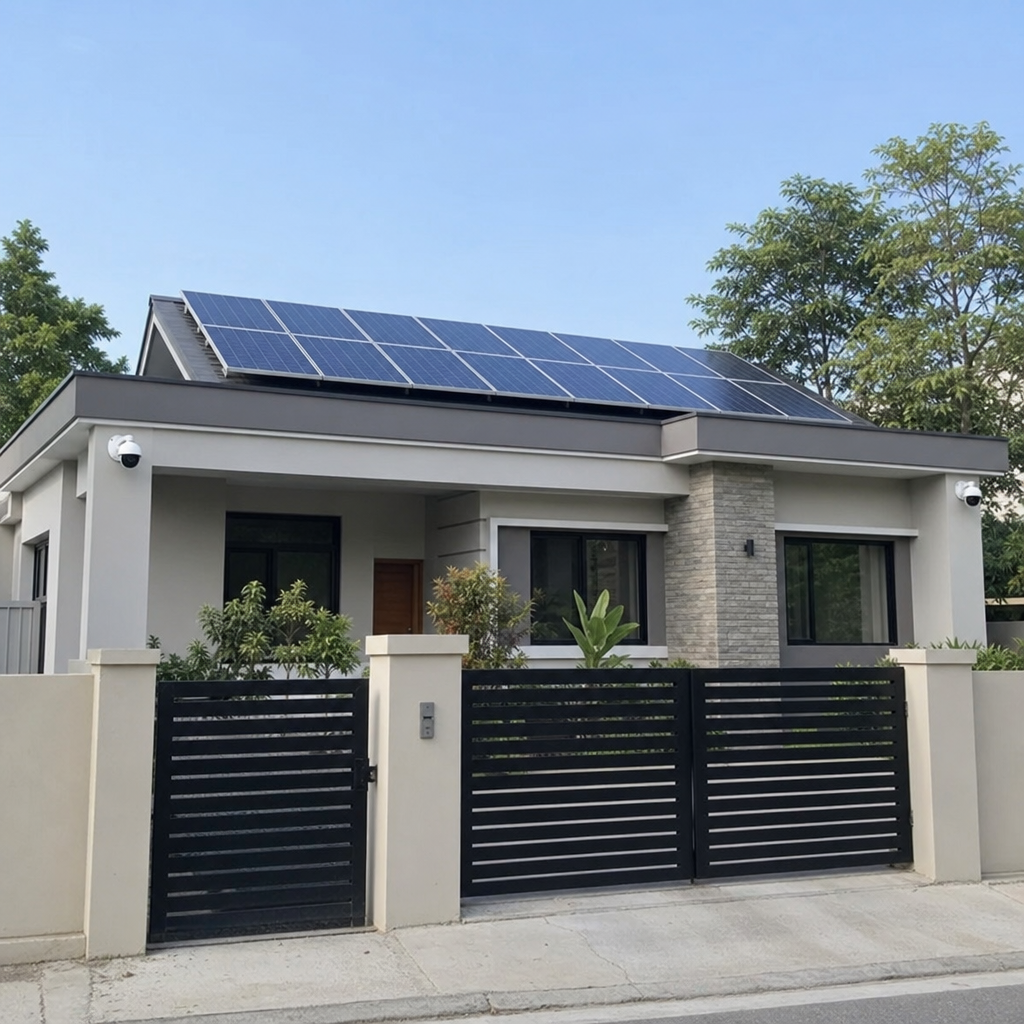
Home security is no longer just about strong locks and bright porch lights. Today, a smarter and more resilient approach is to power critical devices—cameras, motion lights, doorbells, alarms, routers, and even neighborhood-facing floodlights—with solar energy. When you install a solar panel system, you’re not only lowering bills; you’re also strengthening home security by keeping key protections running during outages, reducing reliance on the grid, and enabling always-on monitoring.

Why Solar Power Improves Home Security (Not Just Sustainability)
Security fails most often when power fails. Many modern systems are “smart,” meaning they depend on electricity and Wi‑Fi. Solar power paired with storage can keep your home protected when storms, heat waves, or local grid issues knock out electricity.
Key security-driven solar benefits include:
- Backup power for critical devices (cameras, Wi‑Fi, sensors, smart locks)
- Reliable outdoor lighting (deterrence and visibility)
- Greater independence from power interruptions
- Lower operating costs, making it easier to run more security coverage long-term
When people talk about solar trends, most focus on electric bills and climate. But one of the most practical trends is resilience—homes built to keep operating when the grid doesn’t.
Solar Solutions That Directly Support Security
There are two common approaches, and you can combine them.
1) A Whole-Home Rooftop PV System (Best for Full Coverage)
A rooftop solar panel array can feed your home, charge batteries, and power security circuits. With the right design, your security equipment stays powered automatically.
- Ideal for: whole-home protection, long outages, multiple cameras
- Typically uses a grid-interactive setup with storage or hybrid capability
2) Dedicated Solar Panels for Specific Devices (Best for Quick Wins)
Many homeowners start with device-level solar: a small panel dedicated to a camera or light. For example, people frequently search for setups like ring stick up camera and solar panel because it’s an easy way to add coverage without running wires.
- Ideal for: detached garages, gates, backyards, sheds, rural driveways
- Often uses small panels like a 100 watt solar panel (or smaller) depending on load

How Photovoltaic Cells Work (And Why It Matters for Security Reliability)
Understanding how photovoltaic cells work helps you choose gear that won’t fail when you need it most. PV cells convert sunlight into direct current (DC). An inverter (or microinverters) then converts DC to usable alternating current (AC) for your home. For security loads—often small but continuous—stable conversion and proper sizing are essential.
Security implication: if your system is undersized or poorly configured, your batteries may drain overnight, your cameras may drop offline, or your Wi‑Fi may reboot.
Solar Installation Step by Step (Security-Focused Planning)
A standard solar installation step by step process should include a security layer. Here’s a practical sequence:
- Audit critical security loads List devices that must stay on: modem/router, NVR, cameras, alarm hub, smart lock bridge, exterior lights.
- Calculate your baseline energy needs Use “always-on” wattage and daily runtime. (More on calculate home energy usage for PV below.)
- Choose your system type Decide whether you want grid-tied only, hybrid, or off-grid capability.
- Select the inverter architecture Compare microinverter vs string inverter based on shading, monitoring, and reliability needs.
- Plan battery capacity (if needed) Evaluate solar battery storage benefits for outages and overnight protection.
- Address roof layout and shading Optimize best angle and orientation for PV modules for winter and cloudy-day performance.
- Permitting and interconnection If you’re grid-connected, you’ll handle utility approvals and possibly net metering explained arrangements.
- Installation and commissioning Confirm monitoring, battery behavior, and “critical loads” wiring.
- Security device integration Put cameras and network gear on protected circuits; confirm UPS behavior if you use one.
- Maintenance plan Include inspections, monitoring alerts, and solar panel cleaning service intervals.

Grid-Tied, Hybrid, or Off-Grid: What’s Best for Security?
Net Metering Explained (Why It Helps, and Its Limits)
In many regions, net metering credits you for exporting energy to the grid. Net metering explained simply: your meter can “net” imports and exports depending on rules. This improves payback and boosts solar savings, but it does not automatically provide backup power during outages unless you have the right inverter + battery configuration.
Grid Tied Inverter vs Hybrid Inverter (Security Perspective)
When comparing grid tied inverter vs hybrid inverter, security-minded homeowners usually lean hybrid.
- Grid-tied inverter:
- Great efficiency and cost
- Typically shuts off during outages (anti-islanding safety)
- Not ideal for uninterrupted security
- Hybrid inverter:
- Supports batteries and backup operation
- Can power critical loads during outages
- Better for resilience and security continuity
Off Grid Solar System Setup (When Independence Is the Priority)
An off grid solar system setup is most common for remote properties, cabins, or locations with unreliable grid service. Security advantage: full independence. Tradeoff: higher cost and more careful sizing required (you must cover winter and multi-day cloudy conditions).
Choosing Panels: Output, Efficiency, and Practical Security Sizing
100 Watt Solar Panel vs 400 Watt Solar Panel
A 100 watt solar panel can be suitable for:
- A single camera + motion light (depending on duty cycle)
- Gate sensors or small networking equipment (with battery buffering)
A 400 watt solar panel (sometimes written as 400w solar panel or 400 watt solar panel) is more in the “serious power” category for:
- Multiple devices on a small sub-system
- Supplemental charging for a larger battery bank
- Higher reliability in low-light seasons
The right choice depends on:
- Daily energy use (Wh/day)
- Battery capacity
- Winter sun hours and shade
- Device surge/peak needs (routers, NVRs, lights)
Monocrystalline vs Polycrystalline Efficiency
When comparing monocrystalline vs polycrystalline efficiency, mono panels generally provide higher efficiency and better space utilization—helpful if you have limited roof area or want maximum output to keep security loads and batteries healthy.
If your priority is security uptime, panel efficiency and real-world performance matter more than saving a small amount upfront.
Solar Efficiency: Don’t Confuse Panel Rating With Real Output
Nameplate watts are measured under ideal lab conditions. Real solar efficiency depends on heat, shading, angle, dust, and season.
Calculate Home Energy Usage for PV (A Simple Security-First Method)
To calculate home energy usage for PV, start with what must never go down:
Example “critical security bundle” (illustrative):
- Router + modem: 20–40 W continuous
- NVR / camera hub: 10–30 W continuous
- 4–8 cameras: 20–60 W total (varies widely)
- Smart home hub + sensors: 5–15 W
- Exterior lighting: 10–200 W depending on type and runtime
Then estimate daily energy:
- Watts × hours per day = Wh/day
- Add 20–30% buffer for inefficiencies and growth
This method ensures the solar systems you choose protect the essentials first, then you scale up to cover more of the home.

Solar Power Output in Winter: The Season That Tests Your Security Plan
Many systems look great in summer and struggle in December/January. Solar power output in winter drops due to:
- Fewer daylight hours
- Lower sun angle
- Snow cover
- More cloud cover in many regions
Security tip: size your battery and PV for the worst month you expect to rely on backup. Also, prioritize panel placement with minimal shading and consider steeper tilt where possible to improve winter harvest and shed snow.
Best Angle and Orientation for PV Modules (For Consistent Coverage)
The best angle and orientation for PV modules depends on latitude, roof design, and goals:
- If you want maximum annual production, many homes aim for a balanced tilt and south-facing exposure (in the Northern Hemisphere).
- If you want winter resilience, a slightly steeper tilt can help.
Shading is a bigger enemy than angle. A small shadow on part of the array can reduce output significantly depending on system design—this is where microinverters or optimizers can shine.
Microinverter vs String Inverter: Which Is More Reliable for Security Loads?
The microinverter vs string inverter decision often comes down to shading, monitoring, and how you want failures to behave.
- Microinverters:
- Each panel operates independently
- Better for partial shading and complex roofs
- Panel-level monitoring can help detect issues early
- String inverter:
- Often lower cost
- Good for simple, unshaded roofs
- A single point of failure (in many designs)
Security-minded homeowners often value early detection and partial-operation resilience—especially when cameras and connectivity are at stake.
Solar Battery Storage Benefits for Security and Peace of Mind
The biggest security upgrade usually comes from batteries. Solar battery storage benefits include:
- Keeping cameras and Wi‑Fi running through outages
- Allowing exterior lighting to remain active at night
- Smoothing power for sensitive electronics
- Enabling “critical loads” circuits to stay live even if you shed nonessential loads
If you’re integrating batteries, design your system so:
- Your router/modem and security hub are on the backed-up circuit
- Your camera recorder and PoE switch (if used) are also backed up
- You test outage behavior (simulate a grid loss)

Rooftop PV System Cost: What Security-Minded Homeowners Should Expect
Rooftop PV system cost varies widely based on:
- System size (kW)
- Roof complexity
- Electrical upgrades
- Inverter type
- Battery inclusion (major cost driver)
- Local labor and permitting
From a security perspective, treat it like designing a “power plan” for protection:
- A PV-only system improves bills and daytime operation
- PV + battery improves outage resilience and security continuity
- A critical-loads subpanel can reduce battery size needs by backing up only what matters
Solar Energy Tax Credits and Rebates (Lowering the Barrier to Resilience)
Because incentives can change, homeowners often reduce costs through solar energy tax credits and rebates at federal, state, and utility levels. These can significantly improve ROI and accelerate adoption of the solar solutions that keep security online.
Practical tip: when comparing quotes, ask installers to show:
- Incentives they included
- Assumptions about eligibility
- What happens if a rebate program changes
Maintenance That Protects Uptime: Cleaning, Monitoring, and Repairs
Security is about consistency. Solar is similar: a small maintenance routine prevents big performance drops.
Solar Panel Cleaning Service: When It’s Worth It
A solar panel cleaning service may help if you have:
- Heavy pollen/dust
- Nearby construction
- Birds nesting or frequent droppings
- Long dry seasons with little rain
If output is noticeably down and monitoring confirms reduced production, cleaning can restore performance—especially important before winter.
Common PV System Problems and Fixes (What to Watch For)
Here are common PV system problems and fixes that affect security resilience:
- Sudden production drop → check monitoring, shading changes (new tree growth), or inverter alerts
- One panel underperforming → microinverter/optimizer diagnostics can pinpoint the issue
- Battery not charging fully → review settings, temperature limits, or firmware updates
- Frequent inverter shutdowns → grid voltage issues, overheating, or configuration problems
- Loose connectors or corrosion → requires professional inspection
Solar Panel Repair Near Me: How to Choose Help Quickly
If you’re searching solar panel repair near me, focus on providers who:
- Work with your inverter/battery brand
- Offer diagnostic testing and monitoring review
- Can verify roof penetrations and waterproofing
- Provide clear documentation and warranties
This matters because a weak PV system can quietly undermine your backup strategy. In a prolonged outage, that can translate to lost camera coverage.
Solar Panel Repair: Repair vs Replace
Solar panel repair is sometimes possible for wiring, connectors, mounting, or inverter-related issues. But damaged modules (cracks, severe hot spots, water intrusion) are often replaced rather than repaired.
How Long Do PV Modules Last? (Security Planning Horizon)
A common question is how long do PV modules last. Many panels are built to operate for decades, with gradual output decline over time. For security planning, the key is to treat PV as long-term infrastructure and budget for:
- Inverter replacement at some point (varies by type and usage)
- Battery replacement depending on cycle life and chemistry
- Periodic inspections, especially after severe weather
Using Solar for Outdoor Security Devices: Practical, Actionable Setups
If your goal is immediate security improvement, solar can help you deploy coverage where wiring is hard.
Solar-Powered Camera Zones (Driveway, Gate, Backyard)
Common effective deployments:
- Driveway camera + motion floodlight
- Gate camera with dedicated panel and battery
- Backyard coverage for sheds and side entrances
This is where many homeowners pair devices like a ring stick up camera and solar panel to reduce recharging and keep visibility consistent.
Lighting as a Deterrent (Low-Cost, High Impact)
Outdoor lighting is one of the simplest deterrents. Solar-backed lighting ensures:
- Lights stay available during outages
- You can increase brightness/coverage without worrying as much about the utility bill
Smart System Design Tips for Maximum Security and Solar Savings
To balance protection and solar savings, focus on:
- Put networking on backup: Router/modem and Wi‑Fi access points matter as much as cameras.
- Prioritize critical loads: Back up what protects you; don’t waste battery on nonessential circuits.
- Use monitoring alerts: If PV production drops, you’ll know before it becomes a security risk.
- Plan for growth: Extra cameras, better lighting, EV charging—leave room in your design.
- Consider shade resilience: If your roof has shading, microinverters/optimizers can stabilize production.
Takeaway: Solar Technology as a Security Upgrade, Not Just an Energy Upgrade
Modern solar technology turns your home into a more self-reliant, security-ready space. Whether you start small with a dedicated panel for a camera or invest in full-home solar installation with batteries, the result is the same: fewer weak points when the grid fails, better deterrence through consistent lighting and monitoring, and a practical path toward long-term resilience.
If you want the most security impact, design your solar solutions around the devices that must stay on—then scale the rest of your solar systems for comfort and savings.
Estimated word count (article body): ~2,900 words.
