


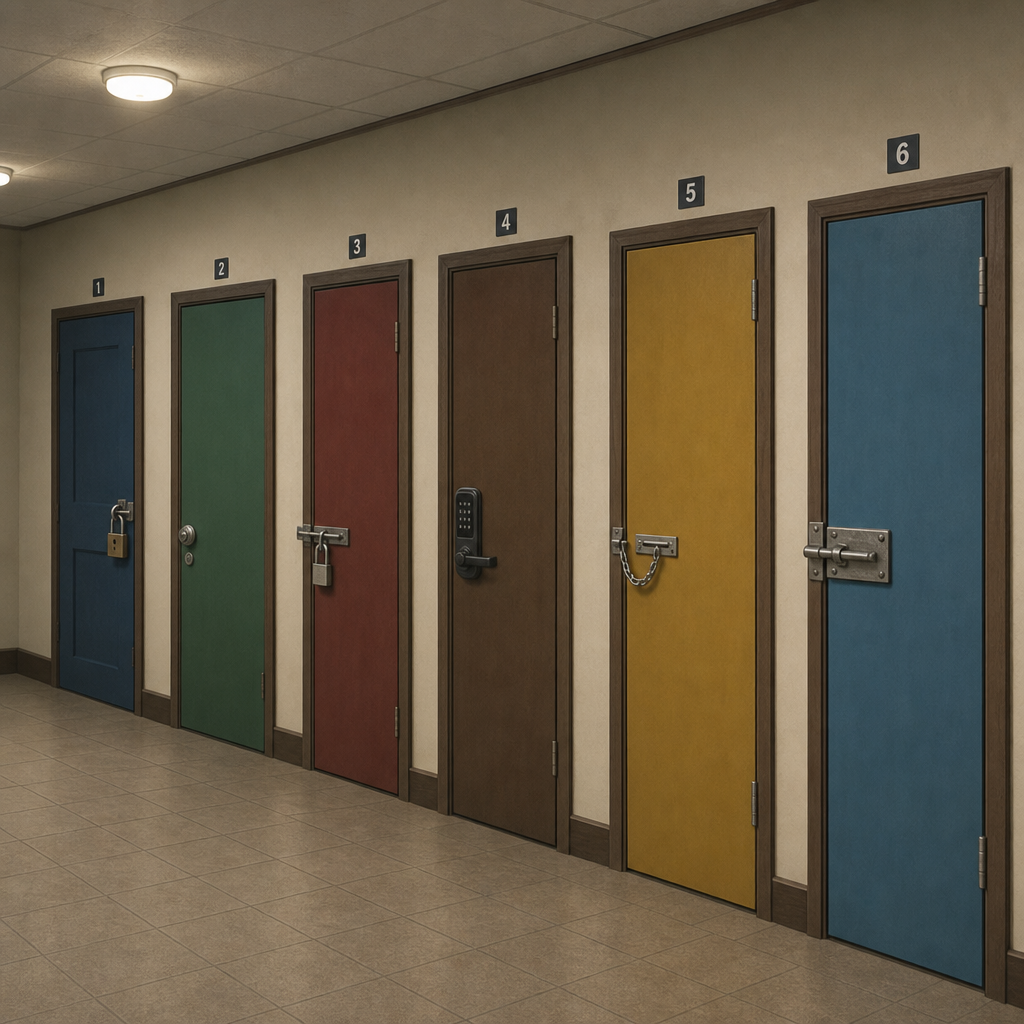
Exploring the Symbolism of Locked Doors
Locked doors are everyday objects—but they’re also powerful symbols. A locked threshold can represent protection, secrecy, fear, power, or a test you’re meant to pass. In stories, games, and real life, we keep returning to the same image: six locked doors standing in front of us, each demanding a different kind of key—courage, knowledge, patience, trust, responsibility, or change.

Why Locked Doors Feel So Meaningful
A door is never just a door. It’s a boundary between here and there, the known and unknown. When it’s locked, the boundary becomes intentional—someone chose control.
Common symbolic meanings of locked doors include:
- Safety and protection: guarding what matters
- Control and authority: who gets access and who doesn’t
- Mystery and curiosity: what’s behind the door, and why can’t you see it?
- Transformation: you don’t walk through the same person you were before
In practical terms, this is why people invest in door security ideas, home safety locks, and modern door lock solutions: we’re not only securing objects; we’re securing peace of mind.

The “Six Locked Doors” Framework: Six Symbols, Six Lessons
If you imagine life as a corridor with six locked doors, each one can reflect a different challenge—and a different “key.”
Door 1: The Door of Safety (Protection, Boundaries, Home)
This door is about choosing security without choosing fear. It’s the symbolic version of upgrading your entryway and saying: My space matters.
Actionable ways to honor this “door” in real life:
- Do a quick door lock types comparison before buying (not all locks are equal).
- Upgrade the frame: improving door strike plate security with longer screws and reinforced plates is often more important than the lock itself.
- Consider keyless entry options if you want fewer keys and more control.
If you’re deciding between deadbolt vs smart lock, ask:
- Do you need remote access, temporary codes, or audit logs? (smart lock)
- Do you want simple reliability and lower cost? (deadbolt)
This is where questions like best lock for home entry and do smart locks prevent break-ins come up. Smart locks can deter opportunistic entry and improve control, but they work best when paired with strong hardware, a solid door, and good installation.

Door 2: The Door of Identity (Privacy, Secrets, Self-Knowledge)
Some doors are locked because you locked them—old memories, unmet goals, parts of yourself you don’t share. Symbolically, the “key” is honesty.
Practical parallel: how you manage access to your life mirrors how you manage access to your property. If you’ve ever needed key management for multiple locks, you know how quickly “who has access?” becomes complicated.
Useful options here include:
- A master key system explained: one key can open many doors while others open only specific ones—powerful in rentals and small businesses.
- Alternative to key locks: keypad or app-based entry can reduce copied keys.
Door 3: The Door of Skill (Learning, Tools, Ethical Ability)
A locked door often introduces a skill check. In fiction, it’s a puzzle; in real life, it can be literal.
People search for lock picking methods for many reasons—curiosity, training, or emergencies. If you’re learning, focus on responsibility and legality first. For educational contexts, think of it as understanding mechanisms, not bypassing security.
If you want a safer, ethical approach, learn how to pick a lock safely only on locks you own (or have explicit permission to practice on), and consider training tools designed for learning. Also, know that door lock rekeying step by step is often a better solution than bypassing a lock when access control has changed (lost keys, tenant turnover, compromised copies).
And when things go wrong mechanically, troubleshooting jammed door lock issues can be surprisingly symbolic: sometimes the “key” is patience, lubrication, alignment, or replacing worn parts—not forcing the door.
Door 4: The Door of Community (Trust, Shared Spaces, Institutions)
Some doors don’t belong to one person. Think apartments, workplaces, and especially locked doors in schools, where the symbolism is intense: safety vs openness, protection vs anxiety.
In institutional settings, door security systems often include:
- Controlled entry points
- Visitor management
- Automatic locks with emergency overrides
- Policies for who can lock/unlock and when
This also connects to a common myth from vehicle discussions: locked doors are less likely to open in a crash. People worry about safety tradeoffs between locking and emergency exit. The real “key” here is using well-designed systems—locks that secure against intrusion but still allow fast, intuitive exit from the inside.
Door 5: The Door of Play (Puzzles, Curiosity, The Pleasure of Earning Access)
Games understand locked doors brilliantly because they turn barriers into motivation. If you’ve ever dealt with hogwarts legacy locked doors, you’ve experienced the satisfying frustration of “not yet.”
Locked doors in games often function as:
- Progress gates (return later with a new ability)
- Lore delivery (what’s hidden matters)
- Skill demonstrations (prove you can do the thing)
If you like structured problem-solving, treat life’s barriers the same way: make a checklist, gather clues, try a method, and iterate. That’s essentially a multi-door security puzzle guide approach—except the “doors” might be finances, career steps, or relationships.
And yes, sometimes you really do need locked door riddle solutions—not because you’re weak, but because collaboration is a legitimate key.

Door 6: The Door of Consequence (Mistakes, Emergencies, Getting Locked Out)
Nothing makes a locked door feel symbolic faster than standing outside it when you’re late. Suddenly, the door becomes judgment.
If you’re wondering what to do if locked out, prioritize safety and damage prevention:
- Check other authorized entries (spare key, trusted neighbor, building manager).
- If you have a smart lock, use backup codes or app access.
- Call a licensed locksmith for non-destructive entry when possible.
People also ask vehicle-specific questions like do police open locked car doors. In emergencies, law enforcement may assist depending on jurisdiction, urgency, and available resources—but don’t rely on that as your plan. A better plan is preventative access management (spare keys, roadside assistance, or keyless access).
Another practical scenario: how to leave car running with doors locked honda. This comes up for quick stops, warming/cooling the cabin, or transporting pets (which has safety considerations). Different models behave differently—some allow it with a second key/fob strategy, others may prevent it. The symbolic takeaway is consistent: convenience without a plan can become an accidental lockout.
Symbolism Meets Reality: Choosing the Right Lock (Without Overthinking It)
In symbolic terms, the “right lock” is the boundary that fits your life. In practical terms, it’s hardware and habits.
Here’s a quick decision guide:
- Want simple, strong mechanical protection? Choose a quality deadbolt; compare brands and grades during a door lock types comparison.
- Want flexible access (codes for guests, schedules, logs)? Consider smart locks and keyless entry options.
- Worried about copied keys? Rekey or upgrade. Use door lock rekeying step by step guidance if you’re experienced—or hire a pro.
Also consider special doors and edge cases:
- Can barn doors be locked? Yes—use hasps, floor bolts, hook-and-eye with padlocks, or specialized barn door latches depending on privacy vs security needs.
- Need childproof door lock options? Choose devices that prevent wandering while preserving emergency egress (especially for exterior doors and hazardous areas).
And remember: the lock is only one part of the system. Reinforce the frame, improve visibility, and keep access organized—because a great lock with poor habits still fails.
Practical Takeaways: “Keys” You Can Apply Today
If you want to turn the symbolism of locked doors into action, start with these:
- Audit who has access (family, guests, contractors): improve key management for multiple locks.
- Fix the weak link: upgrade hinges, frames, and improving door strike plate security.
- Choose friction on purpose: locks aren’t just barriers; they’re boundaries that support your routines.
- Replace guesswork with systems: consider layered door security systems and clear household rules.
Conclusion: Six Locked Doors, One Message
Whether you see six locked doors as a spiritual metaphor, a story device, or a home-security reality, they all point to the same truth: access should be intentional. Some doors protect you. Some doors test you. Some doors teach you. The goal isn’t to unlock everything—it’s to know which doors matter, which keys you need, and which thresholds are worth crossing.
Estimated article body word count: ~1,470 words.
